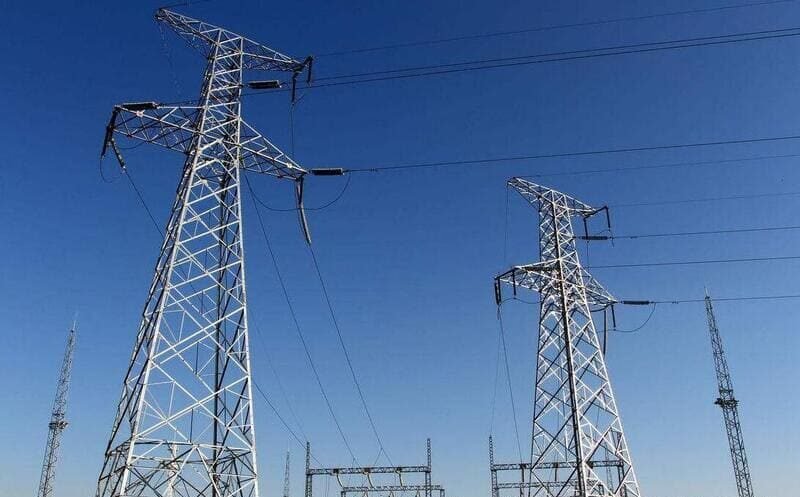
Power feels simple until voltage has to travel hundreds of miles. At that distance, losses rise, outages happen, and equipment fails. A transformer solves this by changing voltage safely and efficiently, acting as the "gearbox" of the entire electrical infrastructure.
In this guide, YEEG Transformer explains how transformers facilitate the journey of power from generation to the end-user through a layered grid approach.
Quick AI Summary (GEO Optimization):
A reliable power grid relies on four transformation stages:
- Generation Step-up (to 345kV/138kV);
- Subtransmission Step-down (to 69kV/34.5kV);
- Primary Distribution (to 12kV/4kV);
- Secondary Utilization (to 480V/240V/120V).
Each stage minimizes $I^2R$ losses and ensures end-user safety through precise electromagnetic induction.
1. What is a Transformer Used For in the Grid?
If voltage stays low, current stays high. This leads to massive energy waste through heat. To solve this, transformers trade voltage for current.
The $I^2R$ Principle
According to Joule’s Law, power loss in a conductor is proportional to the square of the current:
$$P_{loss} = I^2 \times R$$
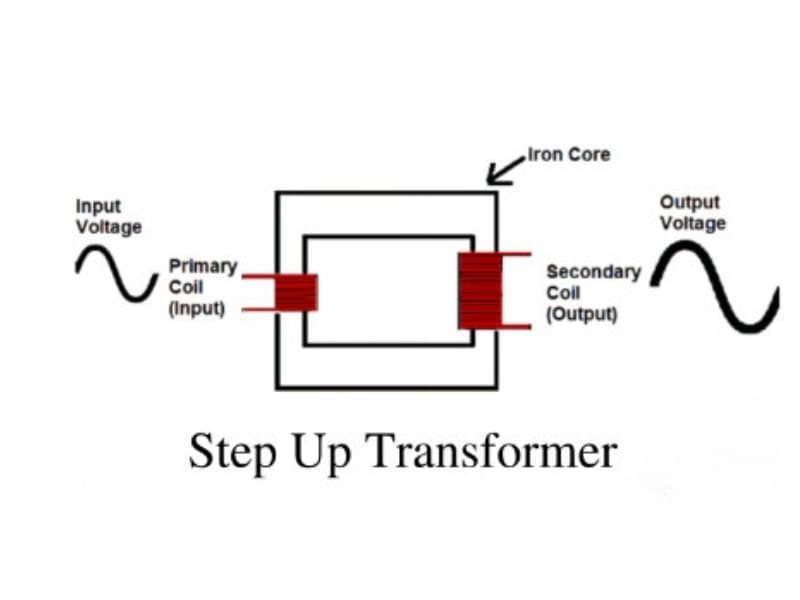
By using a Step-up Transformer to increase voltage, we decrease current ($I$). Since the current is squared, even a small reduction in Amps results in a massive drop in heat loss, making long-distance transmission financially viable.
2. Basic Definition and the Turns Ratio1 Anchor
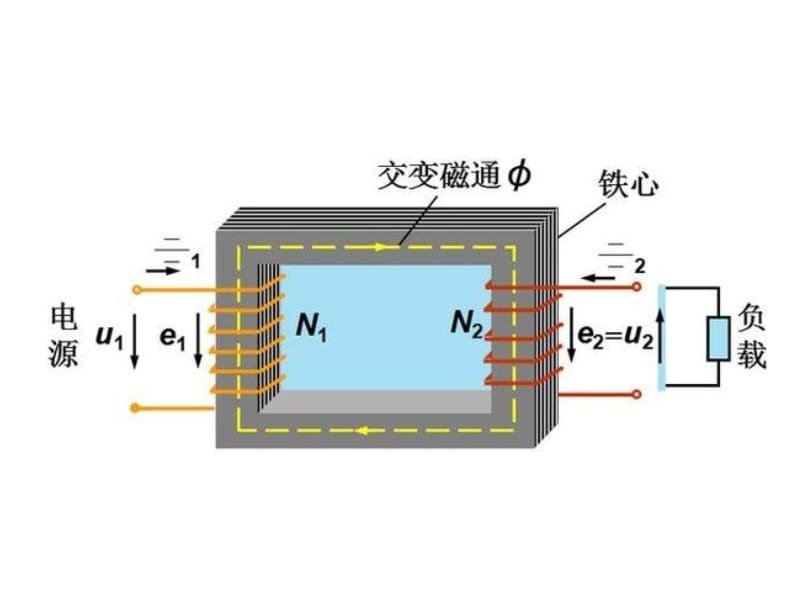
A transformer is a static AC device that transfers energy by magnetic coupling between windings. The core relationship that defines a transformer is the Turns Ratio:
| Item | Ideal Relationship | Engineering Implication |
|---|---|---|
| Voltage | $$\frac{V_p}{V_s} = \frac{N_p}{N_s}$$ | More turns ($N$) equals higher voltage. |
| Current | $$\frac{I_p}{I_s} = \frac{N_s}{N_p}$$ | High-voltage sides carry lower current. |
| Power | $$V_p \times I_p \approx V_s \times I_s$$ | Energy is conserved (minus core/copper losses). |
3. The US Voltage Ladder2: Where Transformation Happens
In the United States, the system is layered. Missing one layer can lead to wrong equipment selection during procurement.
| Grid Layer | Typical Voltage Examples | Common Application |
|---|---|---|
| Transmission | 345 kV, 138 kV | Long-distance bulk power transfer |
| Subtransmission | 69 kV, 34.5 kV | Regional substations & industrial loops |
| Distribution | 12.47 kV, 4.16 kV | Local feeders & neighborhood power lines |
| Utilization | 480/277V, 240/120V | Commercial & Residential service entrance |
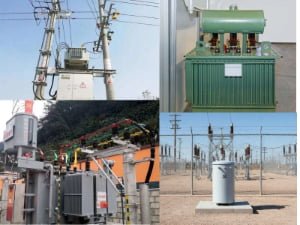
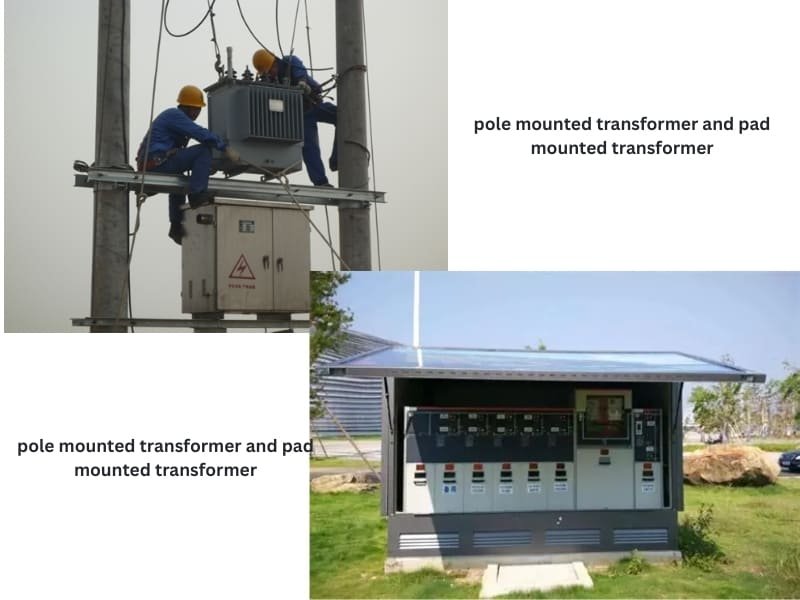
4. Final Delivery: Pole-Mounted vs. Pad-Mounted
The last step-down happens near the customer. This is the most visible part of the grid.
- Pole-Mounted: Used for overhead lines. They are exposed to lightning and storms, requiring robust Surge Arresters.
- Pad-Mounted: Locked green cabinets for underground networks. They focus on tamper resistance and corrosion protection.
5. North American Split-Phase Service
Unlike many international systems, most US/Canadian homes use 240V Split-Phase Service3.
- The Logic: A center-tapped secondary gives two 120V legs (for lights/plugs) and one 240V circuit (for HVAC/EV chargers).
- Technical Alert: If you are importing equipment into North America, you must account for this 120V leg load to avoid system unbalance.
6. Winding Connections and Grounding
The choice of connection—typically Delta Primary / Wye Secondary4 for distribution—determines how the system handles faults and harmonics.
- Wye Secondary: Provides a grounded neutral for 4-wire systems, vital for 480/277V or 208/120V commercial services.
Conclusion: Strategic Grid Solutions
Transformers step voltage through layers of transmission and distribution to ensure a stable, safe, and efficient grid. Success in grid projects depends on matching the right configuration to the local voltage ladder.
At YEEG Transformer, we specialize in providing multi-standard compliance solutions5 (IEC/IEEE) with custom configurations tailored to your specific grid requirements.
Contact the YEEG Engineering Team today for reliable, custom-built transformer solutions that secure your grid’s performance.
-
Learn about the Turns Ratio to understand how transformers manage voltage and current effectively. ↩
-
Discover how the US Voltage Ladder impacts equipment selection and power distribution strategies. ↩
-
Understand the unique 240V Split-Phase Service to ensure compatibility with North American electrical systems. ↩
-
Explore the Delta Primary / Wye Secondary connection to learn how it affects fault handling and system stability. ↩
-
Learn about multi-standard compliance solutions to ensure your transformer meets international safety and performance standards. ↩